
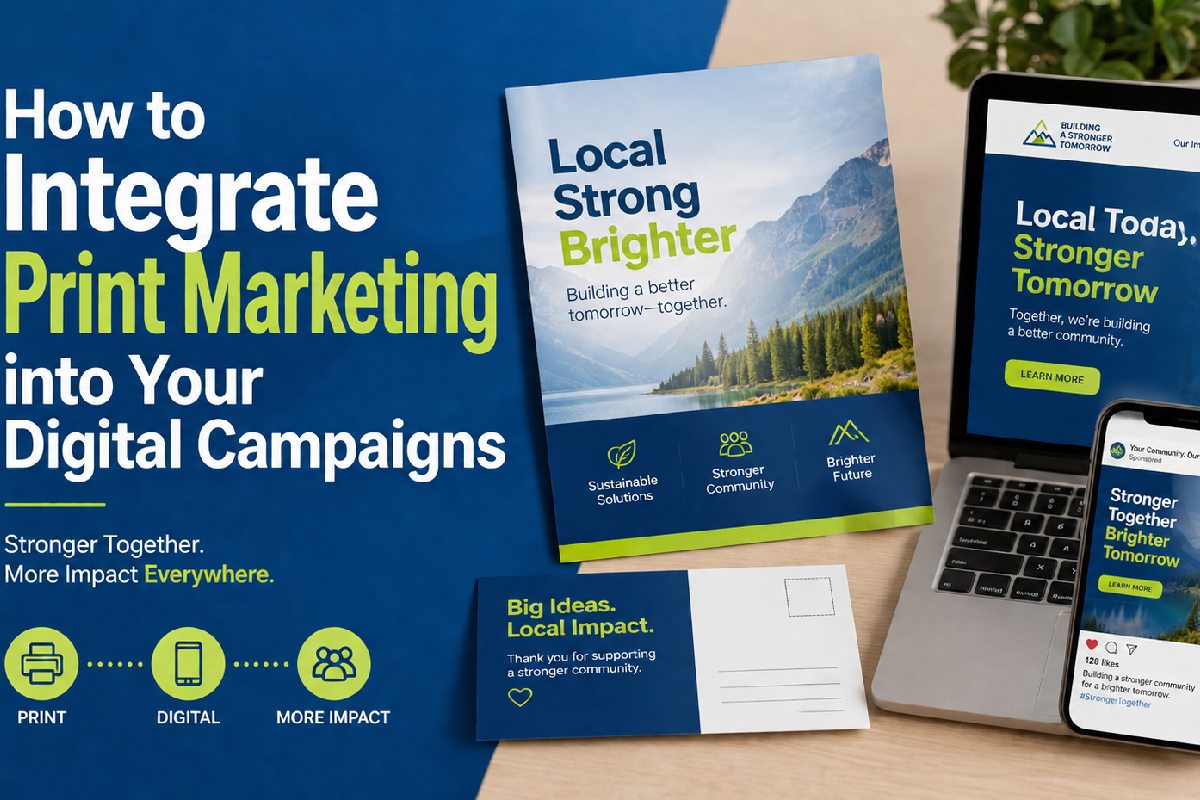
Printing didn’t die – it just had a branding problem. Everyone predicted the paperless office would kill off reports, brochures, and direct mail. It didn’t happen. Instead, the paperless office simply relocated the problem: those same documents now come pouring out of our home printers, burning through overpriced ink cartridges faster than we’d like to admit.
Table of Contents
Why Print And Digital Belong Together
Many people still believe that they have to make a choice: digital ads or flyers, email sequences or direct mail. This interpretation completely misses the mark. Print and digital aren’t in competition – they play different roles in how the human brain processes information. Screen-based content is fast and easily forgotten. Physical is slower, more tactile, easier to dwell on and pass around.
When you combine that deeper level of attention with the pinpoint targeting and tracking of digital, you get a response that neither email nor print could achieve by itself. This isn’t speculation. The average direct mail campaign response rate to a house list is 9% compared to 1% via email (Association of National Advertisers). That’s why we do both.
Making Print Measurable With QR Codes And UTM Parameters
The old argument against print marketing is that it’s hard to measure its effectiveness. But that’s no longer a valid excuse.
Dynamic QR codes combined with UTM parameters are an effective way to track exactly where your print traffic is coming from. Someone scans the QR code on your poster or postcard and – boom – their visit is recorded in Google Analytics. You can see which printed piece referred them, which campaign brought them in, and what actions they took once they landed on your site.
All you need to do is generate a dynamic QR code that points to your unique URL with UTM parameters (source, medium, and campaign) included. Then when your print traffic hits Google Analytics, it automatically shows up as a new segment. Simple.
You can now track conversion rates, cost per acquisition, and return on investment for your print campaign with as much accuracy as your pay-per-click campaign.
Personal URLs (PURLs) even let you track WHO is scanning your QR codes. Instead of sending every person who scans a QR code to the same landing page, they get sent to a unique landing page tied to their name (or customer ID) in a database you control. This lets you track exactly who is responding to your direct mail campaigns with the same granularity as your email campaigns.
Producing Collateral That Actually Works Across Channels
The quality of the physical piece matters more than most digital marketers expect. A QR code that won’t scan because of low print resolution wastes the entire campaign. A flyer where the colors look nothing like the brand’s digital presence breaks the user experience the moment someone lands on the website.
Color management is a practical issue that’s easy to overlook. Digital files use RGB color profiles, commercial printing works in CMYK. Without proper conversion, colors shift – sometimes dramatically. Blues can turn purple. Brand greens can look flat or muddy. The fix is simple. Work with files that have been properly converted before they go to print.
This is where working with a specialist pays off. Partnering with Brightside Print & Design ensures that the physical assets are produced to the technical standard that digital triggers – QR codes, NFC chips, AR markers – actually require to function correctly.
Brand consistency across the print-to-digital handoff also matters for trust. If a prospect scans a QR code on a beautifully designed card and lands on a page that looks unrelated, the journey breaks down. Typography, color, tone, and messaging should feel continuous from the physical piece to the screen.
Variable Data Printing And The Personalization Advantage
Personalization sets the minimum standard for digital marketing. But did you know you can replicate that concept in print?
Variable Data Printing (VDP) allows you to pull from a customer database and alter specific details – name, offer, product image, even the headline – from one printed item to the next, all while the press is running. Send the catalog to your reactivation segment with a cover image that matches their most browsed category. Send it to the prospect list with an image that corresponds to the content of their previous webform.
This is not complex to establish, but you need good data and a printer with VDP-capable equipment. Done right, a direct mail piece can be as timely and appealing as your highest email automation open rate.
Interactive Print Technologies Worth Knowing
NFC (Near Field Communication) chips are small and inexpensive. They require no power and can last for years. They are an excellent choice when physical distance between a user and your communication is a key factor in your use-case, for example, a door entry card. NFC will automatically invoke an action on the phone – this could be to open a website, a GPS location, save a contact, and more.
The use of augmented reality changes the way your customers see their world with engaging and interactive content. AR can bridge the gap between the digital and physical world. The simplest example is using a phone or a tablet to view a product with a visual overlay, and additional info or video. Other ways it is used is in games or searching of a given image in the real world.
Neither technology is necessary for most campaigns. But both are available, and for specific use cases – high-value B2B outreach, product launches, event activations – they can make a piece genuinely memorable in a way a digital ad rarely achieves.
Treating The Customer Journey As One Continuous Thing
The simplest way to explain this is that the customer doesn’t experience channels. They experience a brand. They pick up a flyer, scan a code, land on a page, sign up for email, eventually buy. None of those steps were “print” or “digital” to them.
Your job is to make every handoff clean. The print CTA should tell people exactly what to do. The landing page should match. The tracking should be in place before anything goes to print.
Print, used in this manner, is not a legacy expense. It is one of the highest quality entry points into your digital funnel – and one of the least competitive.