
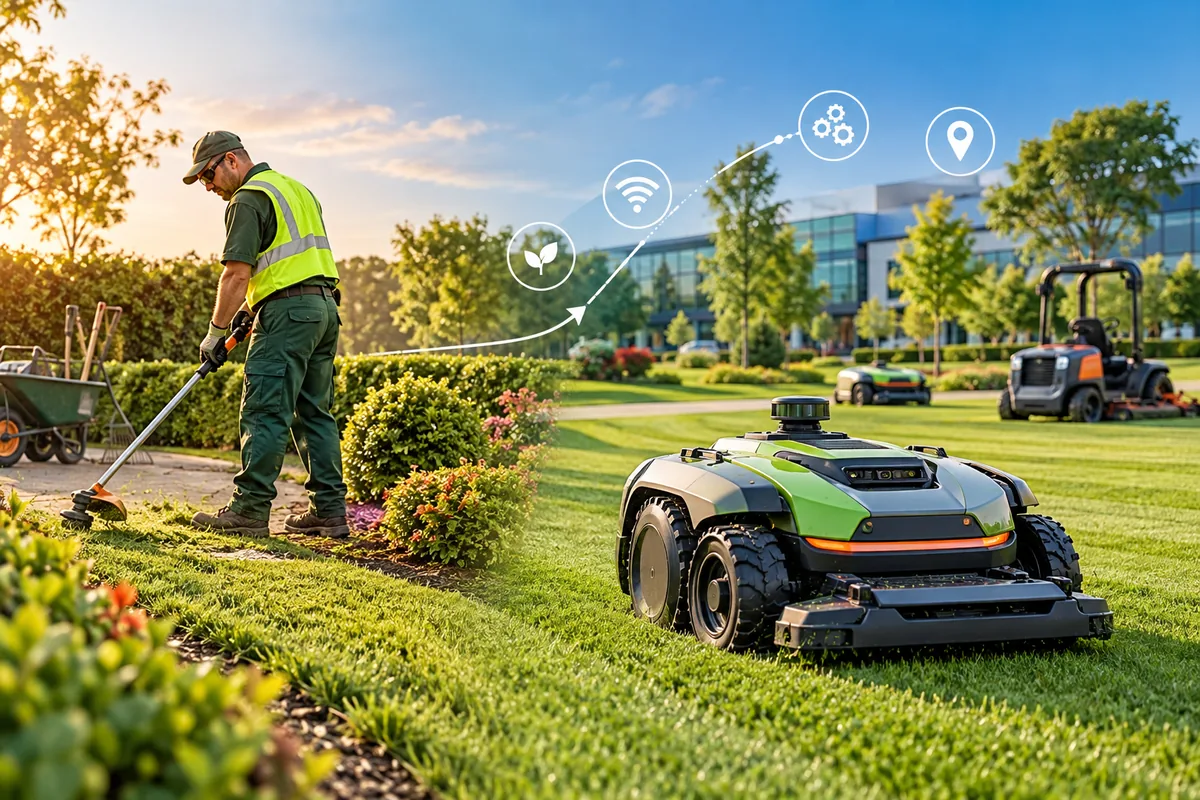
Grounds maintenance has always depended heavily on labour. Lawns need cutting, boundaries need trimming, paths need clearing and large outdoor areas require regular attention if they are to remain safe and presentable. For decades, the machinery changed gradually while the basic operating model stayed much the same: a person controlled the machine and carried out the work directly.
That model is now beginning to shift. Robotic mowers, app-controlled equipment, digital mapping and precision positioning are moving more responsibility from the operator to the machine itself. The result is not simply faster equipment. It is the early stages of a more autonomous approach to maintaining outdoor spaces.
The most obvious example is robotic mowing. Early systems automated the cutting process but still relied on a fairly simple framework. A perimeter wire defined the working area, and the mower operated within that boundary until the lawn had been covered. The technology was useful, but the machine still depended on a physical installation that told it where it could and could not go.
Newer systems are changing that relationship. Instead of relying entirely on buried or pegged wire, some robot mowers now use RTK positioning, virtual mapping and digital zones. The mower can understand its working area through software and satellite-assisted navigation, which allows boundaries to be adjusted without physically altering the lawn. That makes the technology far more flexible, particularly on sites with multiple grass areas, changing layouts or awkward access.
The significance of this shift goes beyond convenience. Once a machine can map an area digitally, it becomes possible to manage the work with much greater precision. Different zones can be treated differently, mowing schedules can be altered remotely and certain areas can be excluded when necessary. A task that once depended almost entirely on human judgement can increasingly be programmed in advance.
For grounds maintenance businesses, this creates an interesting change in how labour may be used. A robotic mower can handle routine cutting while staff concentrate on work that still requires judgement, dexterity or direct intervention. Trimming, repairs, planting, turf care and complex landscaping remain highly dependent on people, but some of the most repetitive tasks can potentially be shifted elsewhere.
That does not necessarily mean fewer workers. In many cases, automation may simply allow existing teams to cover more ground. Labour shortages, rising wages and pressure to improve productivity are already influencing many service industries, and grounds maintenance is no exception. If a team can automate part of the workload without reducing quality, the commercial appeal is obvious.
The technology is also becoming more connected. App-based control means equipment can increasingly be monitored and adjusted remotely rather than managed entirely on site. For larger operations, this could eventually support a more centralised way of overseeing multiple machines across different locations. A manager may not need to stand beside every mower to know whether it is working, charging or has encountered a problem.
Obstacle detection is another area likely to shape the next phase of development. Autonomous equipment is most useful when it can respond to changes in its environment rather than simply follow a fixed route. Gardens, school grounds and commercial landscapes are rarely static. Furniture moves, branches fall, people walk through and temporary obstacles appear. Machines that can recognise and respond to those changes will become far more useful than systems that depend on perfectly controlled conditions.
This is where grounds maintenance begins to overlap with wider developments in robotics. The challenge is not simply to create a machine that can perform one physical task. It is to create one that can understand where it is, what it should be doing and what has changed since the last time it operated.
Battery technology is also supporting this transition. Autonomous equipment needs reliable electric power if it is to operate independently, return to charging stations and resume work with minimal intervention. Improvements in battery capacity, charging speed and motor efficiency therefore have a direct impact on how practical robotic systems become.
There are still limits. Large commercial sites can demand long working hours, while steep terrain, poor satellite visibility and difficult ground conditions may still favour conventional equipment. Autonomous systems also need maintenance of their own, and any failure in sensors, software or connectivity can create problems that are very different from those associated with traditional machinery.
That means the future is unlikely to involve a sudden replacement of manual equipment. A mixed model is more realistic. Human-operated mowers, compact tractors and handheld machinery will continue to handle tasks where flexibility and direct control are essential, while autonomous machines take on work that is repetitive, predictable and suitable for automation.
Retailers and specialists such as Garden Machinery Direct already sit within this transition because buyers are increasingly choosing between conventional wired robot mowers and newer RTK-based systems. That choice is a useful illustration of the wider market. Customers are no longer comparing only cutting width, battery capacity or price. They are also comparing navigation systems, software features and the degree of autonomy the machine can provide.
For businesses supplying or using this equipment, that changes the skills involved as well. Mechanical knowledge remains important, but understanding connectivity, digital mapping and software settings is becoming more relevant. Grounds maintenance is slowly acquiring some of the characteristics of other technology-driven industries, where the physical machine and the digital system around it are equally important.
Over time, this could affect the way maintenance contracts are priced and delivered. A company able to automate routine mowing may be able to offer more frequent cutting without a proportional increase in labour. It may also be able to redeploy staff towards higher-value work, potentially improving both productivity and service quality.
There is still a strong case for caution. Automation works best when it solves a genuine operational problem rather than being adopted simply because the technology is new. A site with complicated terrain or heavy tree cover may not suit an RTK mower, while a small lawn may not justify the investment at all. The most advanced system is not automatically the most appropriate one.
What is clear, however, is that grounds maintenance is moving away from being a purely mechanical industry. Software, mapping, sensors and connectivity are becoming part of the equipment itself. The machine is no longer simply a tool controlled by an operator; in some cases, it is becoming a system capable of managing part of the job on its own.
That transition is likely to continue as positioning improves, batteries become more capable and autonomous navigation becomes more reliable. The long-term result may be a grounds maintenance industry where people still make the important decisions, but machines increasingly handle the repetitive work beneath them.
The shift from manual operation to autonomous equipment is therefore less about replacing human skill and more about changing where that skill is used. The future of grounds maintenance may not be workerless, but it is almost certainly going to be more automated than it is today.