Most companies don’t need an AI team of specialists. They need three or four curious people, a clear mandate, and permission to experiment. The businesses making real progress on AI right now aren’t the ones with the biggest budgets – they’re the ones who gave a small group ownership and got out of the way.
Table of Contents
Steps to build your AI task force
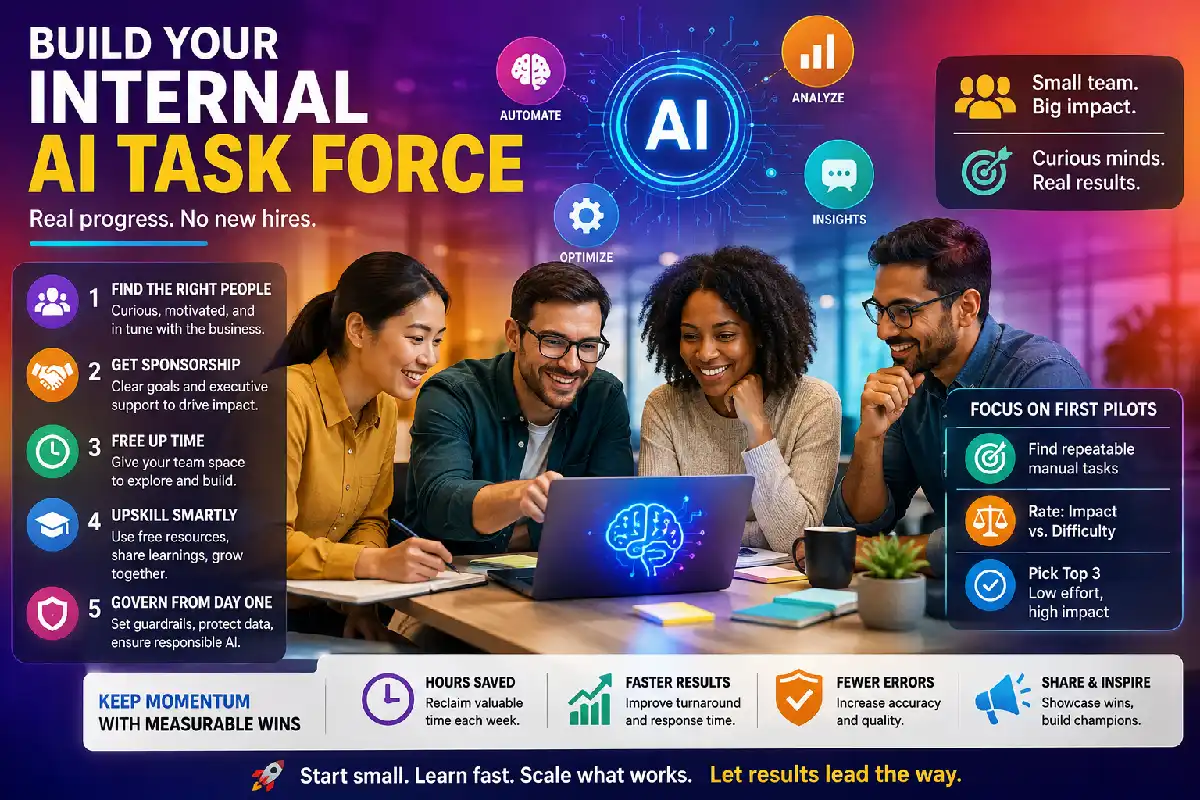
Step 1: Find the right people in your organization
You’re looking for people who are interested in AI – not necessarily people who know about AI. They might be data analysts or IT support staff or marketing managers. They’re excited by new technology, they’re curious, and they understand your business. That last part is important; no AI program has ever started to deliver value without a deep understanding of the business problem it’s trying to solve. You don’t need to hire a team of machine learning PhDs to get that started.
Step 2: Get C-suite sponsorship
Be very clear on what you’re trying to achieve, but be ambitious. ‘We’re going to test some machine learning models and see what new insights we can get from our data’ won’t set anyone’s world on fire. ‘We’re looking to reduce our processing time by 50%, meaning our customer-facing staff can provide a real-time response’ probably will.
Step 3: Free up some time
Your potential AI task force aren’t going to be able to do this on top of their day job. If you’re serious about it, give them permission to spend a specified amount of their workweek on new projects and learning. 80% of what they do will still be their day job, but you’re going to let them test some hypotheses, make some connections, and build some simple solutions.
Upskilling without a training budget
You don’t need a formal L&D program to build AI literacy. Most major AI vendors run free academies and certification tracks that cover practical use, not just theory. Pair that with internal lunch-and-learns where task force members demo what they tried that week – what worked, what didn’t, what surprised them.
There’s a limit to what self-directed learning inside a company can achieve, though. Task forces built entirely from internal trial and error tend to rediscover the same mistakes other companies already solved, and they often misjudge which use cases are actually worth pursuing. This is usually the point where teams that want to move faster bring in outside perspective through ai adoption consulting – not to replace the task force, but to sanity-check the roadmap, sharpen the use case list, and flag the implementation traps that aren’t obvious from the inside. It tends to compress months of trial and error into a few working sessions.
Why AI initiatives stall without ownership
AI projects are not unsuccessful because the technology is not good enough. They fail because no one is responsible for them. A vendor is engaged, someone tests the product for a short period and then the project silently dies as that person is reassigned to some other task. No one is responsible, there’s no knowledge sharing, and there’s no implementation of successful pilot programs. A task force is a solution to all this. It doesn’t have to be a new department or new funding for the next year. It could just be a small cross-functional team of people that meet regularly and are given the mandate to test, experiment, document, and report back. Ownership is key because without it, it’s just a handful of random experiments that get nowhere.
Who should actually be on it
Let’s not focus on job titles. What you need are people who are curious and comfortable with experimenting in a low-risk environment. However, you still need some structure – you’ll want representation from a few different functions to ensure the group doesn’t overlook key issues.
Get one person from IT (they can assess right off the bat if an idea is technically infeasible or insecure), one from operations (they know where the real manual, boring work is that automation could help with), one from legal or compliance (they can identify risk and shut bad ideas down fast), and one from a business-facing team like sales or customer support (they can tell you what customers or revenue could actually care about). Four. That covers all the angles without making this a committee that meets for half a year and then reports out on a PowerPoint.
Scoping the first pilots
Before anyone is allowed to start using a fancy new tool or software, the task force should take 2-3 weeks to do a very mundane but useful job: take an inventory of the various repeatable, manual processes throughout the organization. This could be report writing, data entering, first-draft writing, ticket routing, summary of meetings, anything that is being done in the same manner over and over again by humans.
When you have a complete list, rate each of those items on two criteria: efficiency gain if automated and how complicated it would be to implement automation. The items that score high on gain and low on difficulty are the low hanging fruit. Pick the top three of those. Not ten, not one. Three is a big enough number to have a solid variety of learning experience, and on the other hand a small enough number to avoid the group getting over-stretched.
This step is important in differentiating between a taskforce that does some real work and one that is all about the performance. If we don’t rate them, then we would go and test the coolest looking tool that a vendor has pitched to us.
Governance from day one, not as an afterthought
Before implementing any pilot project, the task force must establish some guidelines that define the limits of the project. For example, which data can be used for the tool, how to select vendors, and when human oversight is required to check the output before it can be shared with the client or used to make a decision.
This does not mean developing a fifty-page long policy. A one-page guideline that is legally and technically feasible will suffice. It is essential to remember, however, that your organization will pay an expensive price if guardrails aren’t created. Sensitive data could be loaded into a tool, or AI-generated output could go out under someone’s name without being reviewed. The worst case is one of your clients learning that something was generated by an AI and reflecting that they could have done it themselves.
Keeping momentum going
Each pilot needs a number attached to it: hours saved per week, turnaround time reduced, error rate improved. Vague enthusiasm doesn’t convince a budget owner. A specific, measurable result does.
Once a pilot wraps, have the task force run a short demo session for the wider organization – fifteen minutes, real numbers, no slides. This does two things. It builds internal AI champions beyond the original four people, and it turns the task force from a side project into something the rest of the company watches and wants in on. McKinsey’s early-2024 State of AI survey found that a third of organizations are now using generative AI regularly in at least one business function, but unclear business cases and skills gaps remain the top blockers to scaling further. A task force with clear ownership and visible wins is how you avoid becoming a statistic on the wrong side of that gap.
Start small, measure honestly, and let the results do the persuading. That’s a lower-risk path to AI adoption than waiting for a bigger budget or a perfect hire that may never show up.